
A-double PBS Certification
Are you maximising your
vehicle’s potential?
Gain access to major ports and industrial sites with higher payload capacity. We guide you through every step of the certification process—from telematics and OBM scales to mass management and access permits.
Why A-Double PBS Certification?
Performance-Based Standards (PBS) certification allows A-doubles to operate on more routes than standard configurations.
Unlock 14 tonnes more payload per trip. Certified A-Doubles can carry up to 14 tonnes more per trip compared with non-PBS B-doubles on similar routes.
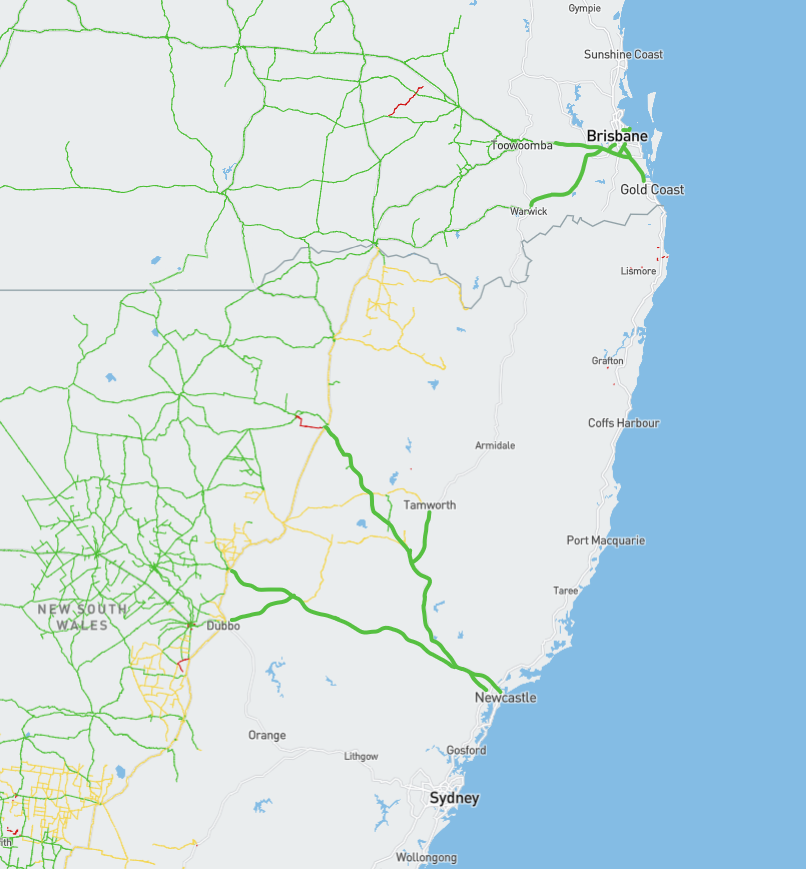
Access premium A-double routes. PBS certification is mandatory for A-double access to major commercial hubs including:
- Brisbane
- Newcastle
- Sydney
- Gladstone
- Victorian PBS Networks
PBS certification enables higher payloads on more routes, which can result in increased revenue for your business.
What Do You Need for A-Double PBS Certification?
1
Dimensions
In Qld and NSW, your A-double must be 30m or less in length to be approved for PBS Level 2. This requirement is necessary to obtain access permits or run on gazetted networks.
In Vic, PBS A-doubles can be up to 36.5m at PBS Level 3 and gain access to the Level 3 Networks.
NSW & Vic High Productivity Gazette Notice →
2
Telematics GPS Tracker
Your vehicle must be equipped with a TCA-approved telematics GPS tracking device that monitors location and operational data.
We can help: We’ll guide you to compatible devices from the TCA approved list and handle installation coordination.
3
On-Board Mass Scales (OBM)
Axle-mounted scales that integrate with your telematics tracker to record real-time mass data for compliance verification must be fitted to the vehicle.
We can help: We supply TCA-approved OBM systems that are fully compatible with your telematics device.
Important: Your OBM scales must be compatible with your chosen telematics device. Check your chosen devices are compatible here
4
Mass Management Accreditation
NHVAS Mass Management accreditation is essential if you want to operate at Concessional Mass Limits (CML) or Higher Mass Limits (HML) and achieve up to 85.5 t GCM.
We can help: Our team specialises in securing mass management accreditation for operators across Australia.
5
Access Permits
To gain access to restricted areas like ports and industrial sites, an NHVR access permits will be required.
Key locations requiring permits:
- Brisbane
- Gladstone
- Newcastle
- Sydney
- Port Kembla
We can help: We complete all permit applications on your behalf, ensuring fast approval.
6
Advanced Braking Systems
PBS approval requires advanced braking technology on both the prime mover and all trailers to ensure maximum safety and control.
Approved braking systems include:
- ABS (Anti-lock Braking System)
- EBS (Electronic Braking System)
- LSV (Load Sensing Valves)
We can help: We’ll verify if your current braking configuration meets PBS standards or guide you through necessary upgrades.
Please Note: The Australian Design Rules (ADR) require prime movers and trailers built after 2016 to have the required braking systems. Dollies do not require advanced braking systems, but will likely comply if built after 2016.
Need help?
We’ll assess your needs, answer your questions, and create a clear roadmap PBS approval.
Common Questions
Tri-Axle or Tandem Dolly—Which Should I Choose?
Both options are suitable for A-double PBS combinations, but the right choice depends on how you operate.
Choose a tandem-axle dolly if: you’re running dedicated PBS routes and want maximum payload capacity. The lighter tare weight translates directly to more revenue per trip. For urban operators running exclusively on PBS networks, this is typically the smarter choice.
Choose a tri-axle dolly if: you operate in rural areas across both PBS and road-train networks. The additional axle provides higher payload capacity on road-train routes, plus the stability and flexibility to handle mixed work.
We’ll help you assess which option best suits your operational needs during our consultation.
How long does the certification process take?
The full PBS certification and access process typically takes 3–4 months, depending on where you’re starting from. Some vehicle modifications, like OBM installation or brake upgrades, may be required before the PBS inspection. (These upgrades are handled separately by qualified suppliers.)
- PBS Inspection & Certification — 1–3 weeks
Assessment of the vehicle and issuing of PBS approvals. - Access Permits — 2–3 months
Road manager approvals and NHVR processing. - Telematics — 2–4 weeks (can run alongside Step 2)
Installation and activation of the required telematics system. - Mass Management Accreditation — 3–4 weeks (can run alongside Step 1)
Implementing your Mass Management system and preparing for audit.
We streamline the process by handling the PBS inspection, permit applications, and accreditation implementation end-to-end, saving you time and reducing delays.
What's the investment for full compliance?
Costs depend on your current setup and requirements. During your consultation, we’ll provide a detailed breakdown covering telematics, OBM equipment, accreditation fees, and permit costs specific to your operations.
Industry Expertise You Can Trust
15+
Years Combined Experience
NHVR
Inside Experience
100%
Compliance Focused
Ready to Get Your Fleet Certified?
Book a consultation call with our team. We’ll assess your needs, answer your questions, and create a clear roadmap to get your A-double fleet PBS certified.